Neousys | PCIe-AE304bp
4-port 100/1000BASE-T1 Automotive Ethernet 802.3bw/bp PCIe card for in-vehicle test, validation and edge computing.
4-port 100/1000BASE-T1 Automotive Ethernet 802.3bw/bp PCIe card for in-vehicle test, validation and edge computing.
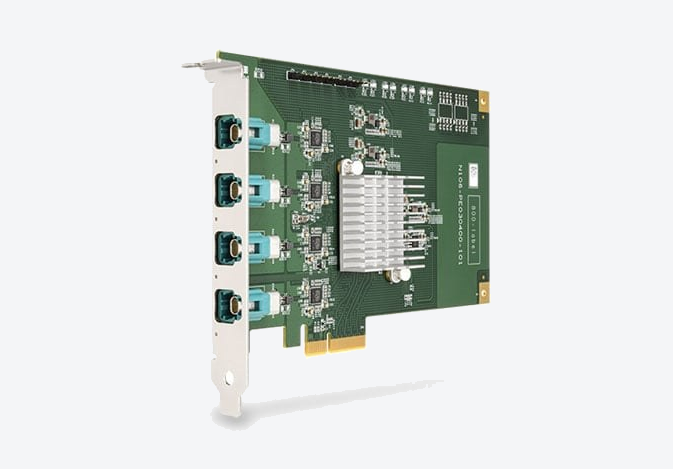
PCIe-AE304bp is a wide-temperature, fanless, four-port Automotive Ethernet PCIe card designed for in-vehicle test, validation and edge computing applications. It provides direct 100/1000BASE-T1 connectivity for x86-based test platforms and edge systems interfacing with high-bandwidth sensors such as LiDARs and radars.
Automotive Ethernet is being adopted across ADAS and autonomous driving, where 100/1000BASE-T1 carries high-bandwidth traffic over a single twisted pair. That cuts cable weight, space and wiring complexity: 1000BASE-T1 serves data-intensive sensors such as LiDAR, while 100BASE-T1 is widely used for radar and other automotive devices.
Built as a single-slot, half-length add-on card, the PCIe-AE304bp integrates four Marvell 88Q2221 Automotive Ethernet PHYs with software-configurable master/slave operation per port. It installs in a standard host without external media converters or extra cabling, and its locking automotive connectors avoid the vibration-related failures seen with RJ45.
Compared with external media converter setups, which add cost, latency, cabling and footprint, the PCIe-AE304bp brings four native Automotive Ethernet ports out of one PCIe slot - a simpler way into BASE-T1 for engineers building ADAS test benches, autonomous driving systems and vehicle electronics validation rigs on standard computing platforms.
Typical applications of the PCIe-AE304bp include:
ADAS test benches built on standard x86 platforms
Autonomous driving validation and data logging
Vehicle electronics and automotive component testing
LiDAR acquisition over 1000BASE-T1 and radar over 100BASE-T1
In-vehicle edge computing where RJ45 cabling cannot be used
What is the PCIe-AE304bp?
PCIe-AE304bp is a wide-temperature, fanless, four-port Automotive Ethernet PCIe card for in-vehicle test, validation and edge computing. It gives an x86 host four native 100/1000BASE-T1 ports through a single PCIe slot, so no external media converters are needed.
Which host systems is the PCIe-AE304bp compatible with?
The card needs a PCIe Gen2 x4 lane signal and fits a x4 slot or a spare compatible x16 or x8 slot. Neousys supplies Linux Ubuntu drivers. It pairs naturally with the Neousys rugged and edge AI computers also available at Leo Drive.
What cabling does 100/1000BASE-T1 need?
BASE-T1 runs over a single twisted pair, up to 15 meters of unshielded twisted pair cable. The card uses locking H-MTD (Z code) connectors, which avoid the vibration-related connection problems of RJ45 in a vehicle.
Can the ports be time-synchronised with the sensors?
Yes. The card supports hardware PTP timestamping to IEEE 1588 v1/v2 and IEEE 802.1AS, reaching sub-microsecond accuracy with connected sensors.
Where is the PCIe-AE304bp available?
The PCIe-AE304bp is available through Leo Drive in the following region: Turkey. For other regions, please contact Leo Drive.
How can I get the datasheet and technical documents for the PCIe-AE304bp?
The datasheet and user manual can be downloaded from this page. Further documentation is on the manufacturer’s website, and you can contact Leo Drive for integration support.
The PCIe-AE304bp is part of the PCIe Expansion Cards range at Leo Drive. Browse all autonomous vehicle sensors and components, or talk to our engineering team about integration in your project.