Calian | CR7712EXF Anti-Jam Two Element CRPA
Two-Element Controlled Reception Pattern Antenna for Jammed Environments
Two-Element Controlled Reception Pattern Antenna for Jammed Environments
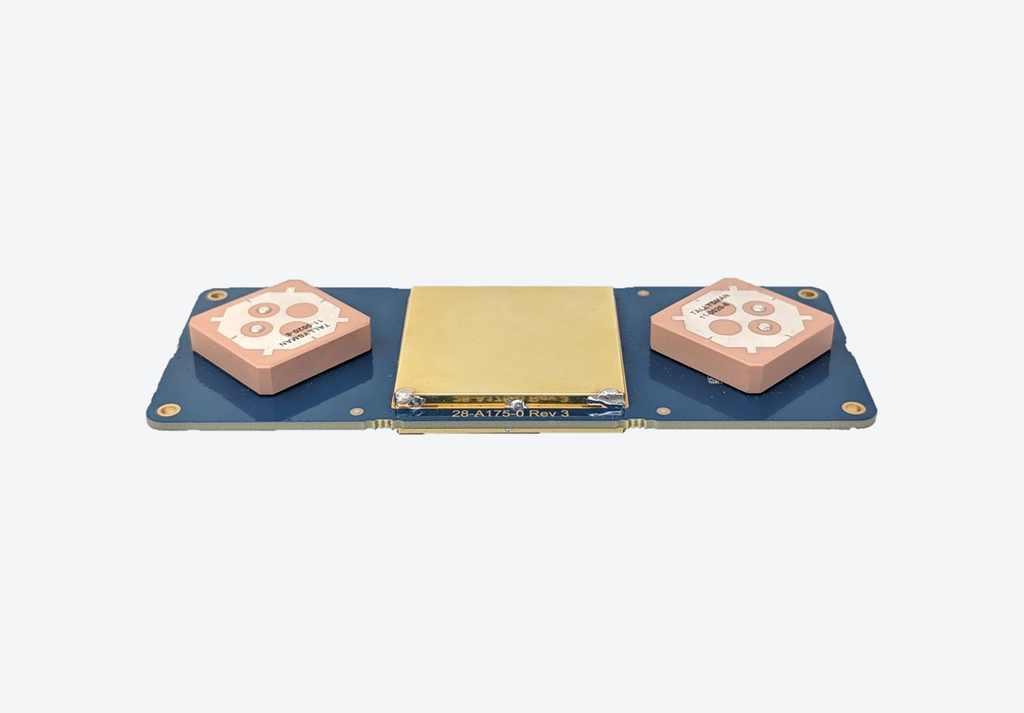
Two-Element Controlled Reception Pattern Antenna for Jammed Environments
Calian’s CR7712EXF embedded Controlled Reception Pattern Antenna (CRPA) GNSS antenna steers 1 planar null to mitigate interference or jamming signals in the upper GNSS band (1559 – 1606 MHz). The output of the CR7712EXF is a standard RF signal (compatible with all Commercial Off The Shelf (COTS) GNSS receivers) with the interference/jamming signals removed. The CR7712EXF also has a serial interface that provides antenna state information indicating jamming detected or not. This feature allows the user to quickly understand the GNSS signal status.
The CR7712EXF utilizes the patented Tallysman Accutenna® technology and a new very low power analog interference detection and mitigation methodology. The product integrates the antenna, interference mitigation, and null forming technology into a light weight and compact enclosure.
The CR7712EXF is a 2-element CRPA designed for single-band Global Navigation Satellite System (GNSS) signal reception. It supports: GPS L1, Galileo E1, GLONASS G1 and BeiDou B1 signal bands. The wide bandwidth antenna elements support the GPS M-Codes on L1.
Intentional and unintentional interference or jamming can saturate a standard GNSS antenna’s Low Noise Amplifier (LNA) such that it may not provide a usable signal. Calian’s CR7712EXF employs two interference mitigating technologies: eXtended Filtering (XF) and Controlled Reception Pattern Antenna (CRPA). XF provides > 80 dB of out of band rejection from 400 MHz to 3000 MHz. Additionally, XF has very sharp band edges around the GNSS bands. CRPA technology creates radio frequency nulls in the direction of the interference/jammer and as a result the antenna provides a clean GNSS signal.
The CR7712EXF embedded CRPA is surface mounted using screws. A standard antenna radio frequency MCX connector and a serial interface connector are the interfaces provided.
Trust Calian to provide a clean RF signal in a noisy RF world.
Formation of 1 planar null
Single band GNSS signal support
Supports eXtended Filtering (XF) providing sharp out-of-band signal rejection
Up to 20 dB null depth
Serial Interface provides state information
Compatible with standard GNSS receivers
Very low power consumption (60 mA typ.)
Small, lightweight, and low-profile form factor makes it ideal for many uses
Supports situation awareness, indicates CRPA state
Critical Timing
Navigation in contested environs
Critical Infrastructure GNSS (airports, etc.)
Law enforcement and public safety
What is the CR7712EXF Anti-Jam Two Element Controlled Reception Pattern Antenna (CRPA)?
Calian’s CR7712EXF embedded Controlled Reception Pattern Antenna (CRPA) GNSS antenna steers 1 planar null to mitigate interference or jamming signals in the upper GNSS band (1559 – 1606 MHz). The output of the CR7712EXF is a standard RF signal (compatible with all Commercial Off The Shelf (COTS) GNSS receivers) with the interference/jamming signals removed. The CR7712EXF also has a serial interface that provides antenna state information indicating jamming detected or not. This feature allows the user to quickly understand the GNSS signal status.
Where is the CR7712EXF Anti-Jam Two Element Controlled Reception Pattern Antenna (CRPA) available?
The CR7712EXF Anti-Jam Two Element Controlled Reception Pattern Antenna (CRPA) is available through Leo Drive in the following region: Turkey. For other regions, please contact Leo Drive.
How can I get the datasheet and technical specifications for the CR7712EXF Anti-Jam Two Element Controlled Reception Pattern Antenna (CRPA)?
Calian supplies the datasheet for this antenna on request rather than as a public download. Please contact Leo Drive and we will arrange it, along with ordering options and integration support.
The CR7712EXF Anti-Jam Two Element Controlled Reception Pattern Antenna (CRPA) is part of the GNSS Antennas range at Leo Drive. Browse all autonomous vehicle sensors and components, or talk to our engineering team about integration in your project.