
By Sibel Turgut · August 2026
If you are learning about robotics, drones, or autonomous vehicles, you will inevitably encounter SLAM (Simultaneous Localization and Mapping). SLAM is the computational problem of constructing or updating a map of an unknown environment while simultaneously keeping track of a robot's location within it.
A massive part of SLAM is Pose Estimation. To track a robot, we need to know its "pose" in 3D space, which consists of:
- Translation: Where is it? (X, Y, Z coordinates).
- Rotation (Orientation): Which way is it facing?
While this sounds simple, keeping track of 3D rotations in a computer is a notorious mathematical minefield. To solve it, roboticists rely on a branch of mathematics called Lie Theory (pronounced "Lee").
Let's see what Lie groups and Lie algebras are, why standard math fails us, and how modern SLAM systems use the "perturbation model" to keep robots on track.
1. The Problem: The Strict Rules of a 4×4 Pose
To understand why we need Lie Theory, we first need to understand how a robot's pose is stored in a computer's memory.
In modern SLAM, a full 3D pose (translation and rotation combined) is represented as a 4×4 Transformation Matrix. Because it has 4 rows and 4 columns, this matrix is made up of 16 individual numbers.
However, a robot does not have 16 degrees of freedom; it only has 6 (moving up/down, left/right, forward/back, and rotating around those three axes). Therefore, you cannot just put any 16 random numbers into a 4×4 grid and call it a valid pose. A valid transformation matrix must obey very strict mathematical laws:
- The Rotation Sub-matrix: The top-left 3×3 section of the matrix represents rotation. Its columns must be perfectly perpendicular to each other (orthogonal), and its size (determinant) must equal exactly 1.
- The Structure: The bottom row must always be exactly [0, 0, 0, 1].
These strict rules mean that valid poses form a highly constrained, curved mathematical surface known as a manifold.
2. Why Strict Rules Are A Problem?
SLAM is essentially a giant optimization problem. A robot moves, uses its sensors to guess its new location, realizes its guess doesn't perfectly match the sensor data, and tries to correct its error.
To correct errors, computers use calculus to find a small "update" step to add to the current guess:
NewPose = OldPose + SmallUpdate
This is where the math breaks. If you take a perfectly valid 4×4 transformation matrix and simply add another matrix to it using standard addition, the strict rules are broken. The top-left 3×3 section will no longer have a determinant of 1.
We need a way to calculate errors and apply updates without ever breaking the strict rules of a 4×4 transformation matrix.
3. Lie Theory: The Manifold and the Tangent Space
Lie Theory provides the perfect mathematical machinery to handle this exact problem. It relies on two fundamental concepts: The Lie Group and the Lie Algebra.
3.1 The Lie Group
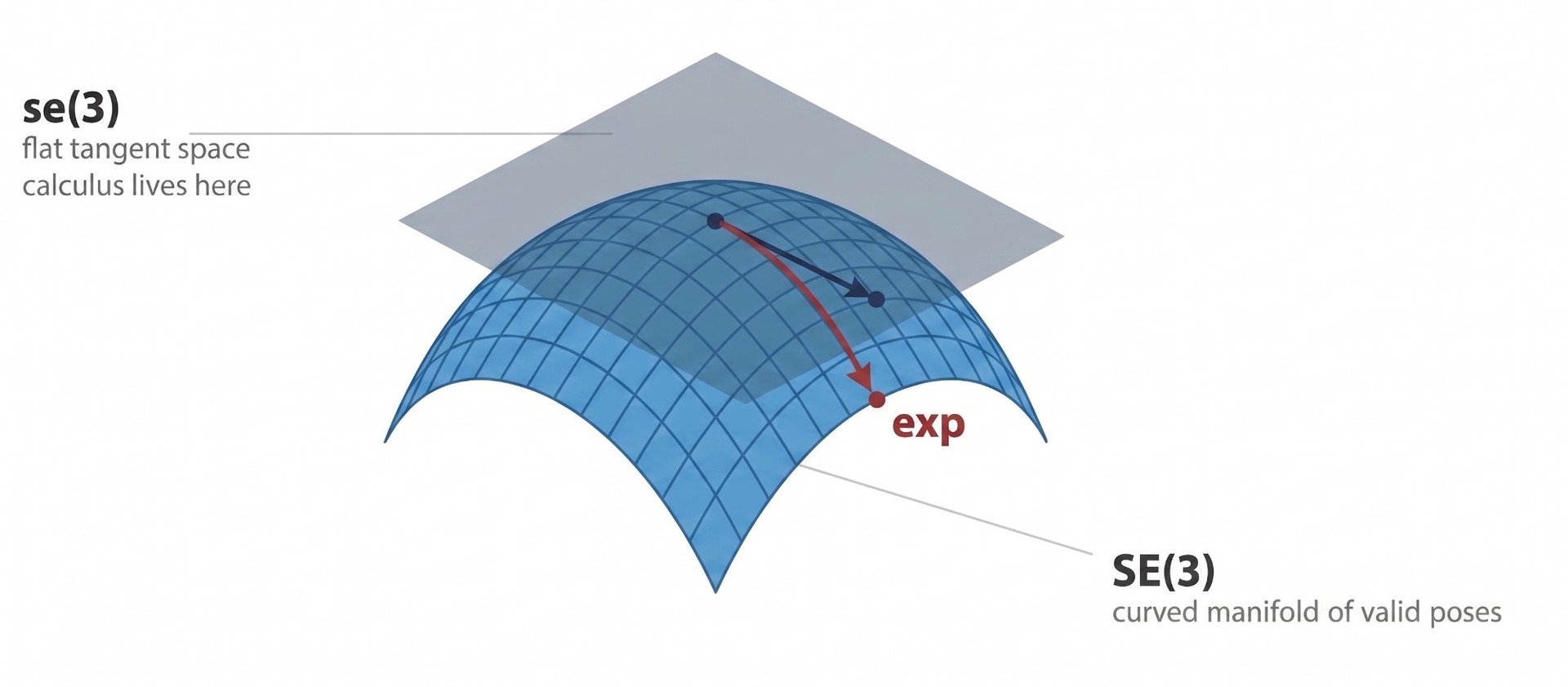
In Lie Theory, that highly constrained, curved manifold of valid 4×4 matrices we just discussed is called a Lie Group. Specifically, the group of all valid 3D rigid body transformations is called SE(3) (the Special Euclidean group).
- It is a Group: It follows specific mathematical axioms. If you multiply two valid SE(3) matrices together, you are guaranteed to get another valid SE(3) matrix.
- It is a Continuous Manifold: You can smoothly move along this mathematical surface to represent a robot smoothly driving through a room.
The rule of the Lie Group is simple: Poses live here, but you cannot do calculus here. Because it is a constrained, curved space. Standard addition and derivatives do not work.
3.2 The Lie Algebra: Flat Vector Space
Every Lie Group has a corresponding Lie Algebra, usually written in lowercase, like se(3).
If the Lie Group is the curved surface of valid poses, the Lie Algebra is a perfectly flat, unconstrained mathematical "tangent space" that touches the manifold.
Because the Lie Algebra is a flat vector space, there are no strict rules here. You can freely use standard calculus, add vectors together, multiply by scalars, and take derivatives without breaking any math.
4. How SLAM Works: The Perturbation Model
We have SE(3) (the constrained manifold where poses are valid) and se(3) (the flat vector space where calculus is easy). How do we use them together?
To optimize a robot's trajectory, SLAM algorithms (like Gauss-Newton or Levenberg-Marquardt) need to find a small "update step" to correct the robot's pose based on sensor errors.
Because we cannot add matrices directly on the Lie Group, we define this small update step, the perturbation, entirely within the flat vector space of the Lie algebra.
We start by representing the tiny error in the robot's movement as a simple list of six numbers: three for the error in its physical location and three for the error in its rotation. Because these six numbers live in a flat, rule-free space, our optimization algorithms can easily run standard calculus on them.
Once we have that perfect six-number correction, we have to apply it to the robot's actual pose. However, we cannot just put a simple list of numbers onto a complex pose matrix. First, a special mathematical operator restructures those six numbers into a grid format. Then, we use a concept called the exponential map to bridge the gap between our two mathematical worlds. You can think of the exponential map as a wrapping process: it takes our flat correction grid and perfectly curls it onto the constrained mathematical surface where valid poses live. This transforms our flat mathematical update into a genuinely valid, real-world physical movement.
Finally, we apply this small, valid movement to the robot's old pose. Because we are now working entirely within the constrained space of valid poses, we cannot use standard addition to combine them. Instead, we use matrix multiplication. In this specific branch of math, multiplying two valid transformations together guarantees that the result is another perfectly valid transformation. The robot's pose is updated, its position is corrected, and the strict rules of 3D geometry are completely preserved without ever breaking the math.
5. Summary
Because a robot's physical state in 3D space is governed by rigid geometric rules, represented by highly constrained 4×4 matrices living on the Lie Group SE(3), we cannot just add or subtract numbers to correct its path.
Lie Theory gives roboticists a brilliant loophole. Instead of fighting the strict rules of the Lie Group, we temporarily step outside of them. The process boils down to three core ideas:
- The Safe Space for Calculus: We calculate our necessary trajectory corrections (the perturbations) as simple, unconstrained 6-dimensional vectors in a flat mathematical playground called the Lie Algebra, se(3). Here, optimization algorithms can crunch the calculus safely and efficiently.
- The Bridge: Once we find the perfect mathematical correction, the exponential map acts as our bridge, wrapping that flat update into a perfectly valid physical transformation.
- The Valid Update: We apply this correction to the robot's old pose using matrix multiplication rather than addition, ensuring the new pose stays firmly on the valid SE(3) manifold.
By splitting the problem in two, storing the pose in a strict space but calculating the errors in a flat space, Lie Theory allows SLAM systems to run fast, complex optimizations without ever breaking the laws of 3D geometry.