
We compare two LiDAR odometry systems that use no prior map and no loop closure (KISS-ICP and DLO) on five sequences of the Boreas-RT dataset, under identical hardware, three runs per configuration. We additionally run DLO with its IMU input disabled.
1. Summary of Findings
- KISS-ICP uses 44x less memory than DLO, 220MB mean peak resident set against 9.7GB, and it never exceeds 262MB on any sequence while DLO reaches 14.4GB.
- KISS-ICP has lower local drift on four of five sequences, by 1.6x (snowy) to 3.4x (suburb). DLO leads only on highway, where both systems have already failed.
- Both systems fail on highway. KISS-ICP drifts 7.16m per 10m driven and finishes 865m from the reference; DLO drifts 5.87m and finishes 811m out.
- DLO's IMU makes no consistent difference. Disabling it changes drift by less than run-to-run variation on forest, snowy and urban; it degrades suburb (1.30 to 1.55m) and marginally improves highway. Mean over the five sequences is 2.23m with the IMU and 2.22m without.
- KISS-ICP is deterministic where it works. Standard deviation across three runs is 0.000 for drift, both RPE components and ATE on forest, snowy, suburb and urban. The only sequence with any run-to-run spread is highway, the one where it fails.
- Both systems sustained real time. Real-time factor stayed within 0.998-1.000 for all 45 runs.
2. Setup
KISS-ICP runs through a wrapper we wrote. Its own ROS package moved to ROS2 only at v0.4.0, and the last ROS1-compatible tag is a year of algorithm development behind current. Rather than benchmark a stale version, kiss_icp_ros1_node.py wraps the current core library (PyPI v1.3.0, matching the git tag) directly. This is a Python process, which matters for the CPU figures but not the accuracy ones.
DLO's IMU had to be rotated before DLO saw it. DLO has no extrinsic calibration mechanism
anywhere in its source, yet integrates raw gyro readings into a per-frame rotation prior. Fed
uncompensated data it would compute every prior in the IMU's axes rather than the LiDAR's. A helper node rotates angular velocity and linear acceleration by the same extrinsic used everywhere else in this project and republishes; DLO consumes the rotated topic. Its cost is charged to DLO in the resource accounting, since it is genuinely required to run DLO correctly on this rig.
3. Local Accuracy
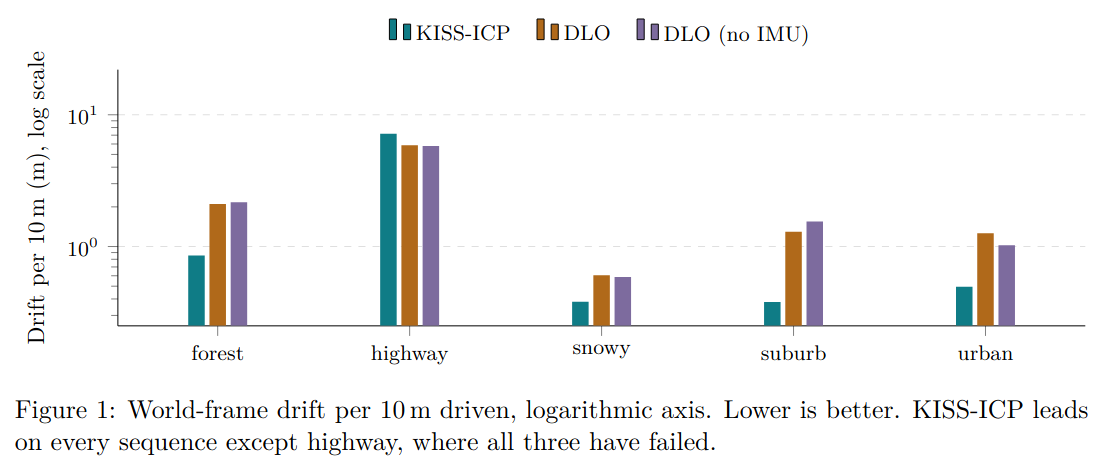
KISS-ICP is ahead on forest, snowy, suburb and urban, by factors of 1.6 (snowy) to 3.4 (suburb). Expressed as a fraction of distance travelled it holds 3.8-8.5% on those four sequences against DLO's 6.1-21.1%.
The ordering is the same in body-frame RPE, and rotation is where the three configurations come closest: 1.13-1.49° per 10m segment across every system and sequence except highway. Whatever separates these systems, it is not attitude estimation over short intervals.
4. Global Accuracy
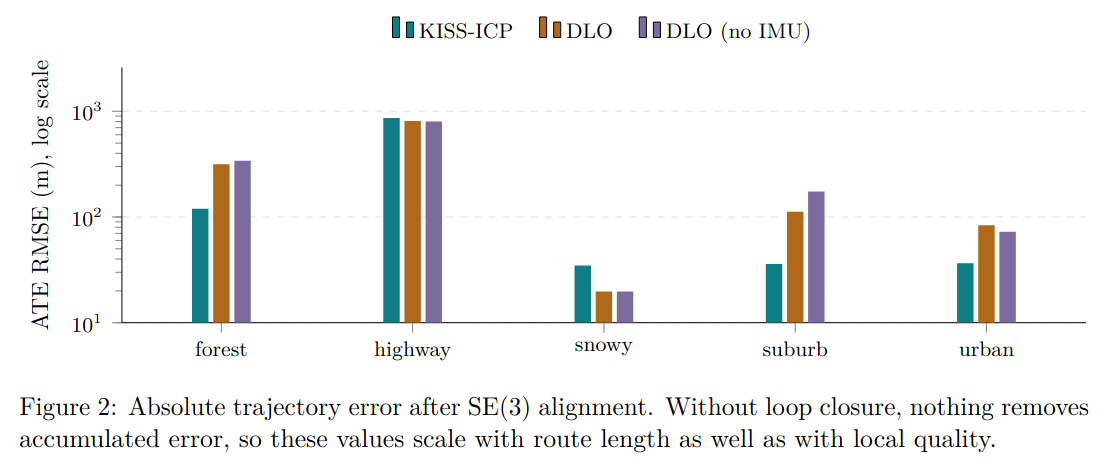
Figure 2 shows global error dominated by the absence of any correction mechanism: none of these systems can recover from drift once it has accumulated, so ATE is largely local drift integrated over the route. KISS-ICP's advantage in Figure 1 carries over on forest, suburb and urban; DLO leads on snowy, and the two are close on highway where both are already far outside anything useful.
5. Computational Cost
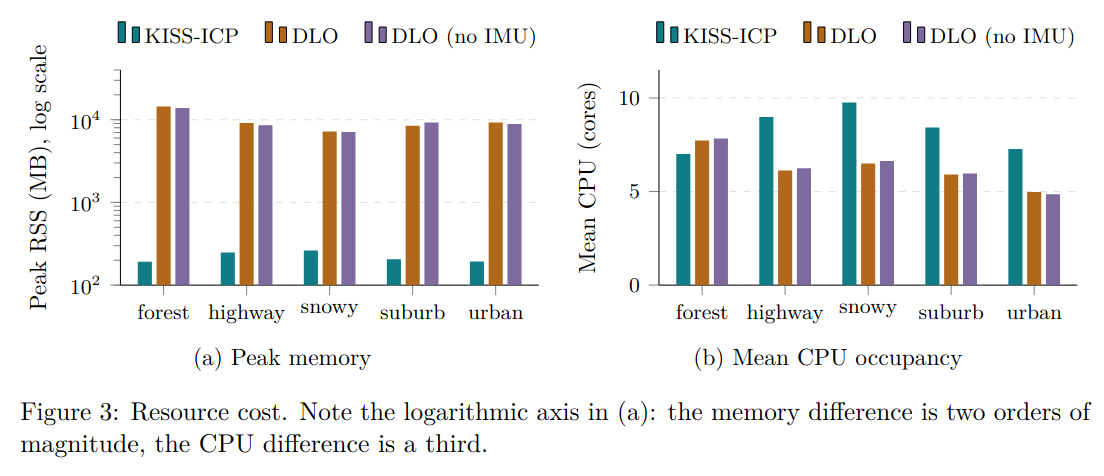
The memory result is the largest single difference measured anywhere in this project. KISS-ICP's mean peak resident set is 220MB; DLO's is 9.7GB, a factor of 44. KISS-ICP never exceeds 262MB on any sequence, including the 2001s urban route, and shows no trend with route length. DLO ranges 7.2-14.4GB, with its maximum on forest.
KISS-ICP bounds its voxel hash map by a maximum range, so what it holds is a rolling distance-bounded window rather than an accumulating history, which would account for a flat footprint. DLO retains keyframe submaps. The measurements are consistent with that account; we did
not profile allocations to confirm it.
6. Full Results
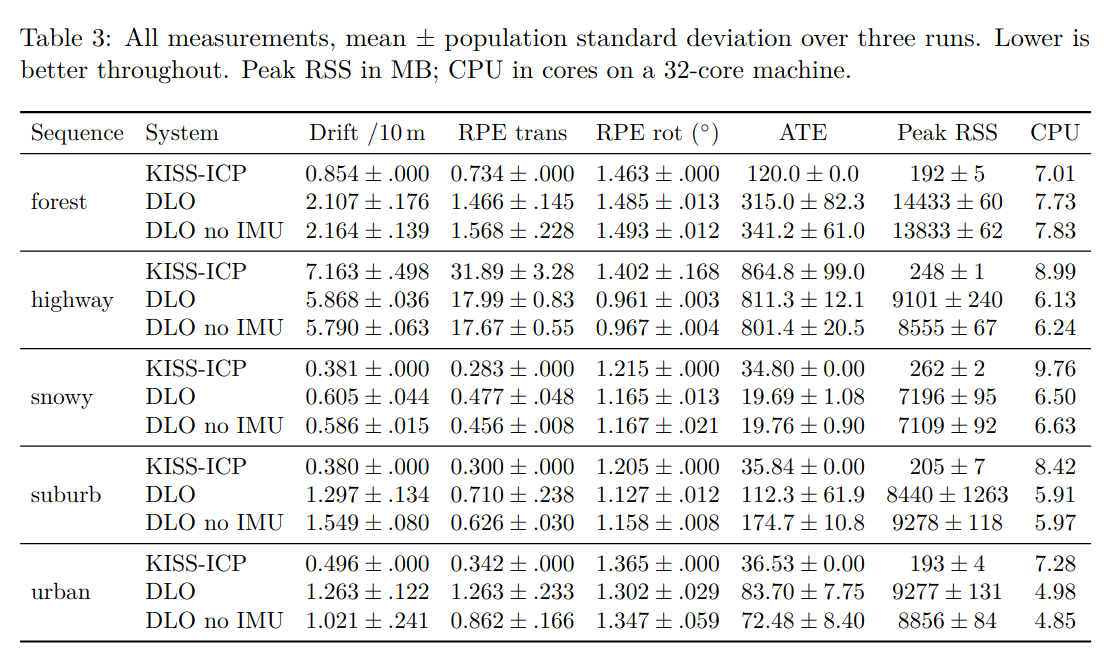
Real-time factor was 0.998--1.000 for every run and is omitted from the table for space. DLO's run-to-run spread is substantial on two cells - ATE ±82m on forest and ±62m on suburb - which is itself worth noting: a system whose outcome varies that much across identical repeats is reporting something about its own stability, not just its accuracy.
7. Conclusion
Between these two systems, the choice is not close on cost and is mostly not close on accuracy either.
KISS-ICP produced lower drift on four of five sequences while using 44x less memory, and it is reproducible to three decimal places on every sequence it handles. At 220MB it is the only system in this benchmark that would fit an embedded target without argument. Its CPU figure is
higher than DLO's, but that measurement is confounded by our Python wrapper and should not be read as a property of the algorithm.
DLO leads on snowy and is more stable than KISS-ICP on highway, but carries a 9.7GB footprint and shows large run-to-run variation on two sequences. Its inertial prior - correctly rotated, and integrated on every frame - did not measurably improve its odometry on any sequence in this set.
Both systems fail on highway. That is the practical boundary this group establishes: without either an inertial prior or a correction mechanism, scan-to-scan registration on this dataset degrades to unusable on the one route that combines high speed with sparse geometry.
Reproducing these numbers. The harness, the parameter changes applied to each system, and the scoring code are at https://github.com/leo-drive/SLAM-and-Localization-Benchmark (Apache-2.0).
Reproducing these numbers. The harness, the parameter changes applied to each system, and the scoring code are at https://github.com/leo-drive/SLAM-and-Localization-Benchmark (Apache-2.0).
[1] D. Lisus, K. M. Papais, C. Le Gentil, E. Preston-Krebs, A. Lambert, K. Y. K. Leung and T. D. Barfoot, "Boreas Road Trip: A Multi-Sensor Autonomous Driving Dataset on Challenging Roads," arXiv:2602.16870 [cs.RO], 2026.
[2] https://github.com/vectr-ucla/direct_lidar_odometry
[3] https://github.com/PRBonn/kiss-icp